


Carolina House Trust is one of Scotland’s oldest children’s charities. Based in Dundee, they offer support to foster carers, children and young people, to provide nurturing homes which allows children and young people to reach their full potential. This includes therapeutic family-based care for children and young people who can’t live with their birth family and may have experience of trauma or have complex needs; and a host-family service offering family-based care for asylum seeking children and young people.
Their staff team of 11 includes social workers, support workers, administrative, finance, HR and marketing professionals.
Carolina House Trust (CHT) is a Living Wage accredited employer, and one of only three social care employers in Scotland that is also Living Hours accredited. They were recognised by A Great Place to Work 2025 as one of the Top 10 Small Employers in the UK for overall experience, development, and wellbeing.
In conversation with staff at CHT we wanted to understand the benefits and challenges of funding in children’s social care, and what lessons from their approach to business, and staff satisfaction could be useful for adult social care organisations.
The Employee Experience
Growth Mindset, and an active investment in this for both staff and foster families characterises the culture at CHT. Growth Mindset is the belief that our basic skills can be improved upon, through effort and hard work. A central principle is framing mistakes as learning opportunities, learning from them and then moving on and removing any culture of blame. People and Development Officer, Charlene Bowman, describes this as creating an environment of ‘psychological safety’ and has noticed more openness and willingness for staff to make suggestions for improvement since CHT began embedding Growth Mindset.
At each staff meeting there is time given to celebrate achievements but also to acknowledge learning opportunities: learning from where something has not gone to plan. Charlene noted how the leadership team led the way by sharing their learning opportunities openly, until other staff grew in confidence to share their own challenges. Over time it has been embedded into the culture to the extent that people freely share and reflect together. At monthly supervision and annual supporting performance reviews, staff are given the opportunity to reflect further on their achievements and learning opportunities on a one-to-one basis.
As well as being lived out in workplace interactions, Growth Mindset has been embedded into all HR processes and introduced to everyone involved with the organisation, including board members, volunteers, foster carers and young people. At induction all staff are introduced to the principles and invited to give feedback on the induction process as an example of growth in action. Where appropriate, Growth Mindset is embedded into ongoing training offers, for example resilience and trauma informed sessions.
As well as organisational benefits such as retention and innovation, the team noted some less tangible benefits: ‘it’s a nicer place to be when we are in the office’
This overall ethos is supported by a well-developed People and Wellbeing strategy, which linked directly to the priorities in the strategic plan and focussed on growth mindset, learning and development, wellbeing, engagement and recognition, resourcing and organisational development.
At Christmas, there is an opportunity to celebrate success: each staff member receives reflections from the team about what they have achieved over the year, to ensure efforts are recognised and celebrated.


SECURITY
In contrast to much of the social care sector, the small team has a low turnover and high retention. At the time of our visit, the average length of service for the team was sitting at 8 and a half years. All contracts are secure. Meeting the requirements for Living Hours accreditation, everyone works a stable shift pattern, and all have a contract which accurately reflects the hours they work. As well as the immediate impact on individual staff of being able to budget and plan financially, this also contributes to the feeling of psychological safety in the workplace: it is much easier to own mistakes and grow, when your hours and contract are secure.
EFFECTIVE VOICE

Feedback from employees is valued within CHT and considered a useful tool for the organisation. There are tangible examples of where employee voice has led to meaningful change, for example, enhanced annual leave allowance meaning public holidays are additional, not part of the original allocation. Employee requests also led to the introduction of paid emergency leave for dependents, death in service benefit, and an enhanced offer for parental pay including maternity, paternity, shared and adoption pay. Where changes have not been immediately possible, for example around increased employer pension contributions, there is a clear culture of revisiting and re-evaluating regularly as circumstances change.
Most importantly, this has been communicated clearly, and those who put forward ideas are given an outline of why they have not been implemented. Charlene explains: ‘I hate the thought of people thinking what is the point in surveys, nothing ever happens’. She gives an example of where there was a request to move to a four-day week. In response she researched, read reports and spoke to other organisations and presented her findings to the leadership team, followed by the staff team. The idea was not implemented, but it is clear it was given robust and meaningful consideration, which it is hoped will encourage staff members to keep making suggestions.
As well as in-built opportunities to provide feedback at team and individual meetings, CHT have two annual staff surveys, one exploring employee engagement, and another focused on wellbeing. These are staggered to ensure that feedback is given, or change is implemented before the next survey comes out to minimise the chance of employees feeling unheard.
OPPORTUNITY
Training is part of what CHT offers to the foster carers and young people they support. This extensive training offer is extended to all staff members from CHT, and recent focus has included trauma-informed approaches, resilience and wellbeing, as well as specialist input on neurodiversity or foetal alcohol syndrome. This year, this amounted to around 30 different training sessions.
‘We think it is really important that although not every role is with carers or young people, we have a broader understanding of what the challenges are. It’s good for our own development’ says Charlene.
Feedback is taken after each session including requests for future training, which, where possible, is added to the variety of sessions available in the next year. Alongside this formal training offer, working in a small third-sector team means there are opportunities for staff to learn and develop skills through supporting colleagues and the wider work of the organisation.
FULFILMENT
‘We call ourselves a community, every member of it is important’
Sara Lovelock, former Chief Operating Officer
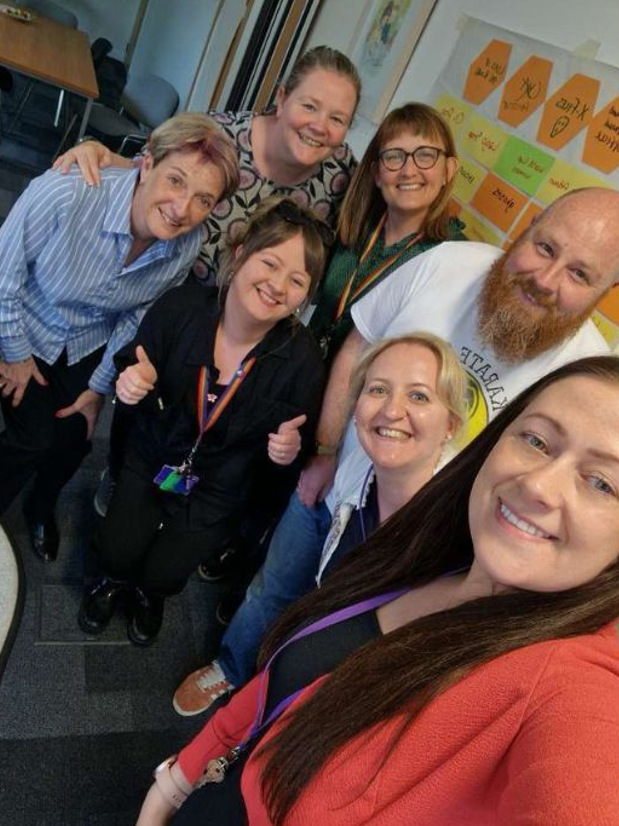
Growth Mindset has a clear impact on the organisation, and the work of CHT beyond the immediate team is framed by this. There is a culture of acceptance and safety. Speaking about their work in bringing together staff and children with their foster families, Sara reflected on a broader purpose of the organisation:
‘We’ve completely changed our language as part of Growth Mindset and also the Promise. We don’t talk about difficult behaviour; we talk about behaviour rooted in trauma. We don’t talk about children running away: they are not home yet. We put different structures around children in care: if your own children are ten minutes late you wouldn’t say they have gone missing’
There is ongoing work in framing social care, and CHT have been part of this, including ensuring their own branding avoids unhelpful stereotypes used to represent foster care, such as ‘children in hoodies looking grumpy’. The radical acceptance running through all of the work is central to a culture of fulfilment and safety.
RESPECT
Flexible working is offered to all staff, and the team are keen to attract the best candidates to any open roles through making this a clear feature in job adverts. Charlene explains how she advertises roles as ‘up to 35 hours’ so potential employees feel more confident in asking for what they need. Just as importantly, flexibility is modelled by all staff including the leadership team: ‘almost everyone is on some kind of flexible-working arrangement whether it is part-time or compressed hours’
‘I condense my hours, so work-life balance is brilliant’ Calum McKenzie: Office Supervisor
Sara Lovelock reflects, ‘Productivity isn’t based on someone having to sit at a desk 9-5: it’s ok to have fun as a team together, it’s ok to work in a way that suits you’
She added the importance this has in retaining parents and others with care responsibilities in the workforce, knowing that they can answer a call from the school and parenting can run alongside work rather than bending to it.
What next?
Recruitment of foster carers is a challenge – not just for CHT but across the UK. Carer populations are ageing, and there are not the same numbers of younger people coming in to fill the roles. It’s not like changing a job, ‘it’s a complete life change’ so it is a challenge finding people with the right skills and nature. In particular, CHT are seeing that people who may have come to foster caring once their children left home are doing so later, as children are staying home longer due to the cost-of-living crisis. Indirectly, this is having an impact on the ability to recruit foster carers and the length of time they can give to fostering.
Reflecting experiences in adult social care, salaries for the charity do not fully align with what is offered by the local authority. Their income is impacted by lack of carers and they too are under financial pressure due to cost of living pressures.
‘We only want to choose the best foster carers’
As with many adult social care organisations, CHT are negotiating between the absolute best service they can provide to the young people, and the carers they support, whilst also working to support, maintain and develop their workforce. The demand for foster care currently outstrips the supply, and it is important that organisations can continue to work to ensure that young people are supported into nurturing homes that allow them to reach their potential.
Despite challenges, CHT continue to work to be innovative and to continue to grow. The staff team are very clear as to why: ‘It’s the right thing to do’, and even whilst circumstances change, the core value of the team will remain.