

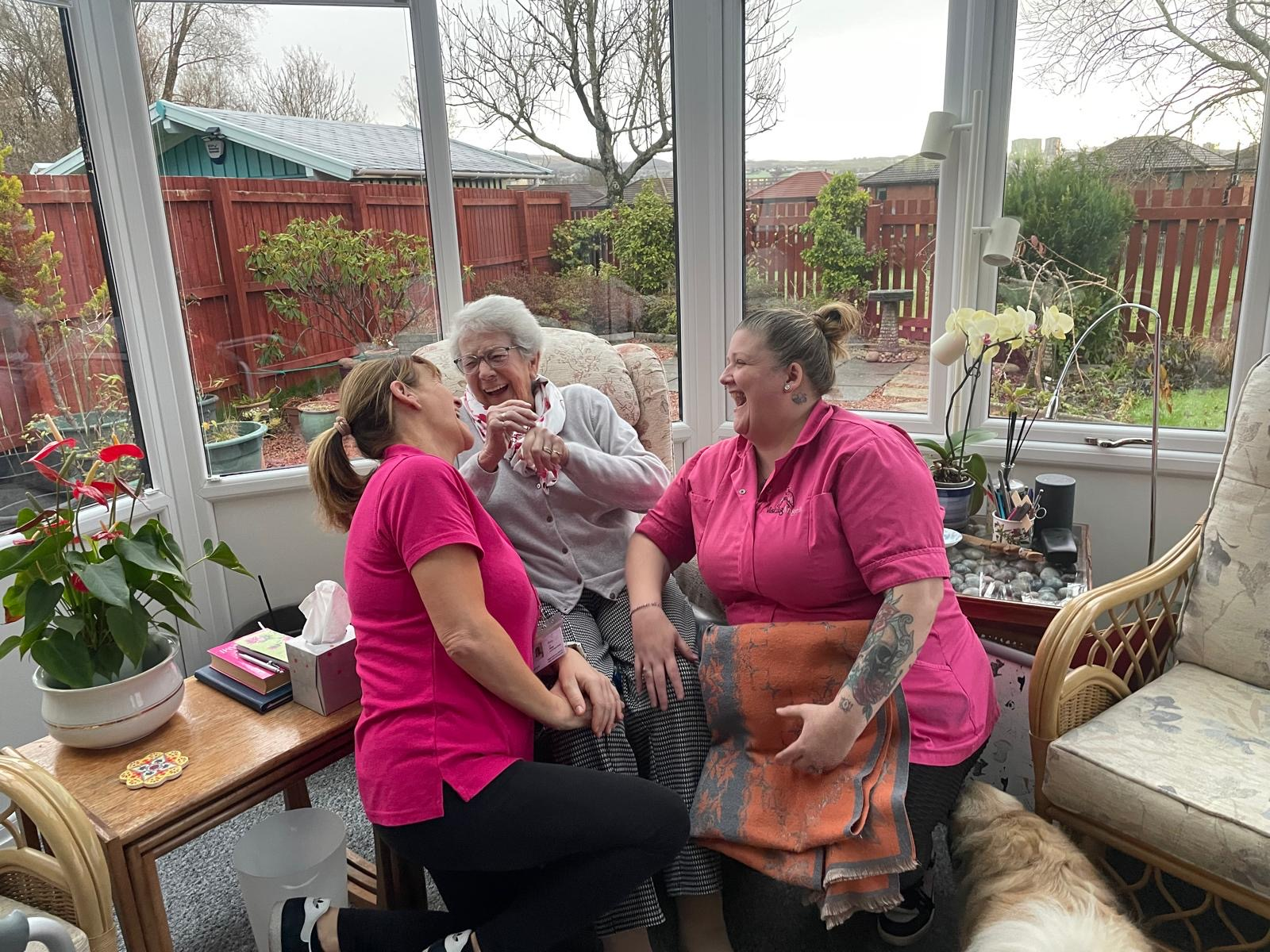
Based in Renfrewshire, Visiting Angelz provides care in the community for adults of all ages who require additional support, allowing people to stay happy and well at home. The team is made of around 35 staff, and they support around 100 people.
Support includes personal care, social inclusion, domestic input such as shopping, and anything else a person may need to allow them to thrive. Care is built around individual requirements, for some people this might be support in the mornings and evenings, for others this may be help shopping once a week or changing their bed. A consistent staff team and rota mean care workers build up strong relationships with the people they support. A team member explains:
“Watching them go through the good and the bad – we are by their side through it all. We’re their support system”
The team prioritise building those relationships and this impacts on the way that they work. Service co-ordinator Angela explains: Relationships are more than a nice to have, they are essential to undertaking care. If people don’t build relationships and build trust, they are less likely to accept the care that they need.
Visiting Angelz are a Living Wage employer, as well as being one of only a handful of social care services in Scotland who are an accredited Living Hours employer.
The Employee Experience
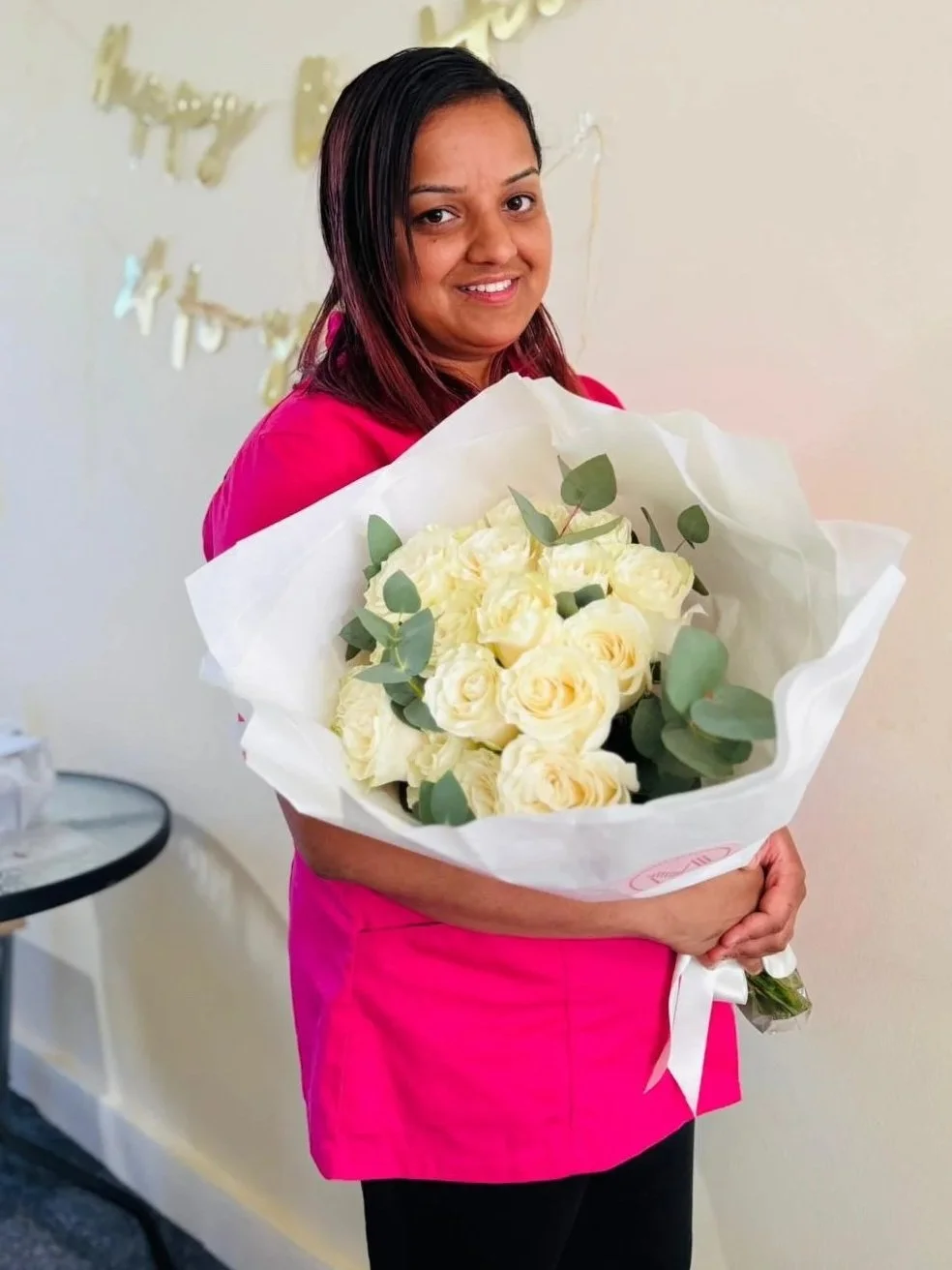
Managing Director, Angela Magee credits the organisations small size in allowing them to make an attractive offer to staff: ‘I don’t have shareholders, I don’t have partners – other businesses aren’t as fortunate. For me it just comes out of my pocket – it’s as simple as that.’
The Fair Work principles align with the values of Visiting Angelz and complement the way they choose to work.
Similarly, they found the process of becoming Living Hours accredited to be ‘amazing’ – the Living Hours team made the approach to Visiting Angelz and identified that they might meet the requirements, and they realised they already met them. Angela explained: ‘It came completely left-field and I was delighted that we got it’.
SECURITY
As an accredited Living Wage and Living Hours employer, all Visting Angelz employees are paid at the real Living Wage rate or above, offered a guaranteed minimum of 16 hours a week, at least 4 weeks’ notice of shifts, payment if shifts are cancelled and provided with a contract that accurately reflects hours worked.
“A lot of the time people will come in and the first thing they ask – will I get a contract? Especially the younger ones who want to get houses or whatever, so that security is there for them”
While there is a culture of transparency, the management are keen to protect staff wellbeing and are conscious of repeating narratives about the unsustainability of social care. Whilst she is open about challenges and change needed more broadly, Angela explained: ‘The team work very hard and we don’t want them worrying about the unsustainable sector, or the sector being in trouble. Their jobs are secure.’
EFFECTIVE VOICE
Two team members laugh: ‘we’re good at talking’. Joking aside, strong communication is central to Visiting Angelz practice. There are formal mechanisms for feedback provided through regular employee surveys, and whole team meetings. However, the culture of communication is embedded in the daily life of the organisation.
“One thing I like is the team is always sticking together, willing to help – in fact it is more like family here and I love that. They are open with information”
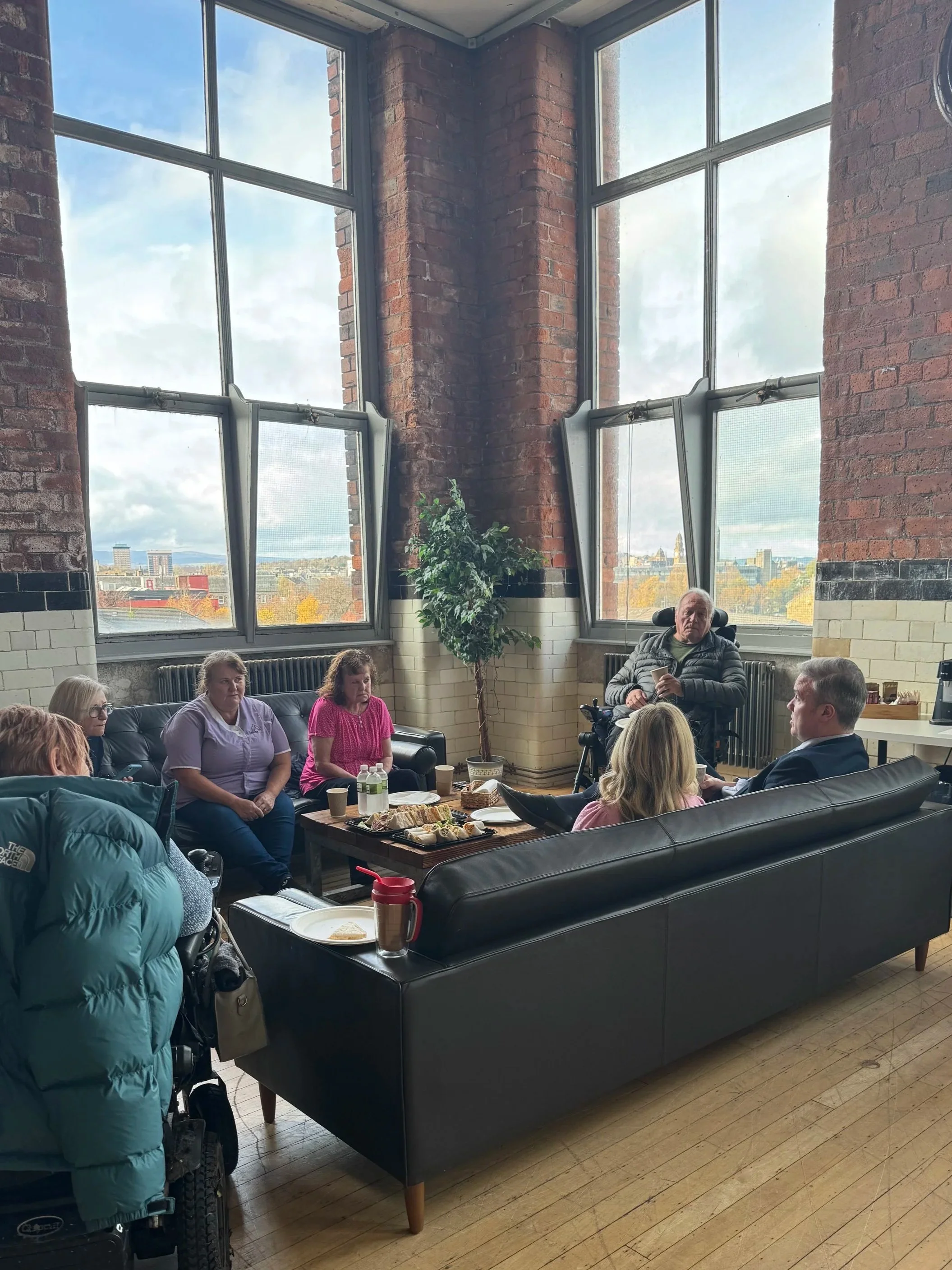
The office is open, with space available for ‘people to come and chill out, watch some TV’ and direct approaches to management are encouraged about any issues. Communication is prioritised, as Care and Support Worker Kirsty explained: ‘You’ve got to have good communication otherwise it would all fall apart’
Job security also promotes effective voice, through allowing employees the freedom to express their opinions, knowing they are safe and stable in their employment.
OPPORTUNITY
Staff are given enhanced training and skills bespoke to their client needs for example, around dementia. Training is given in-person by a local provider who know the organisation and ways of working well. This is supported by a culture of peer support, observations and learning from each other.
Multiple supervisors or coordinators began as frontline staff before moving into more senior roles. However, the team are keen to keep in with care and support, and many choose to still directly support clients. Service co-ordinator Fiona explained: ‘I think it’s important that service users and family members know who their point of contact is, rather than just speaking to someone on the phone’
FULFILMENT
The team are unanimous about the best part of the job: making a difference in people’s lives.
“I enjoy the opportunity to help. It gives me joy to make an impact on someone’s life, and put a smile on people’s faces”
Beyond the joy in relationships, the staff team also reported feeling fulfilled by seeing the practical differences they make for people they support:
“If we can keep them independent in their home we are making a difference. It’s even the nitty gritty things like – people can have a pet at home, if they move to a home, they are losing their pet”
RESPECT
Managing Director Angela works with a staff team that she trusts, and the employee policies reflect this. Visiting Angelz also offer unlimited private healthcare, including around counselling or mental health support. Fuel cards are provided on trust, and Angela explains ‘workers will never be out of pocket for fuel when they are out at work’.
Similarly, Visiting Angelz always provide people with the equipment they need to work. Operations Manager Lyndsey explained: ‘You don’t pay for your uniforms, you don’t pay for your PVG, all that happens is you come to work and you do the best you can do’. This feeling was echoed by the team:
“This has been my first position in social care and I feel at home – like I have done this for ages, because of the great support that I have received from the team”
What is different?
Managing Director Angela is open that Visiting Angelz are impacted by the same challenges as the rest of the sector, but she credits their success to transparency; inviting the team to input on how to give the best care within the constraints of funding; ‘how do we give the best care in the half an hour we have got?’
Care and Support Worker, Grace, summed this up when she said: ‘We work as a team. It helps us as individuals. I see that team spirit here, if anything here comes up, it is sorted’
Challenges for the Social Care Sector
Funding and budget cuts
Managing Director, Angela reflects on the impact of reduced government funding as the local authorities are under financial pressure, and this is reflected in the amount they pay independent providers: ‘Everything comes back to cost sadly, and making something work with the resources that you have’.
Angela shared that the local authority sometimes assesses someone as needing only 15 minutes of support. She explains:
We don’t do fifteen-minute calls – we have never ever done them. It’s barely enough time to make a cup of tea, or to walk someone to the toilet. It takes away the opportunity for bonding with another human being, for chatting, listening – so no fifteen minute calls, they are never ever done.
However, as the local authority will only cover the cost of a fifteen-minute call, the additional cost needs to be met somewhere, and often this means transferring the costs to the family and that is a huge challenge. Angela remains positive, however, saying: ‘It just makes you get more creative with the funds that are coming in’
She is clear that the people being supported should not know, or experience the challenges the organisation is under, and explains how the team work together to deliver the best service they can within limited budgets helps.
Training
Every care-worker by 5 years into the post needs an SVQ Level 3. Service coordinator Fiona explained how this requirement was challenging for some staff members. She reported some feeling ‘‘Why do we need to do this when we’ve been doing the job for 10 years?’ and ‘a fear of the unknown’ for those who may have not studied since childhood.
However, the team explain how they all support each other to complete it. Fiona acknowledged that Visiting Angelz staff work towards the qualification because they are happy in their job, but there is always a risk of losing team members due to this requirement. Additionally, whilst there is funding available for the cost of the course, paid time for study is not funded and this takes away from their own time, and presents a disproportionate barrier to those with caring responsibilities.
Recruitment and Immigration Policy
Recruitment has been a persistent challenge in the social care sector – even with high retention, staff members leave, for example through retirement, and it is a challenge to replace them. Managing Director, Angela notes that nearly all the applicants for posts are international workers, which means the workforce is overly reliant on immigration policy. Reflecting on Home Office policies, she said: ‘it is hard to keep up with, they change policy with short-notice and seemingly on a whim. There are delays in the process too: one application to sponsor more workers has been sat with the home office for over 6 months, with no further update.’
This substantial uncertainty impacts on future planning. Angela also raised how important the international students are in her workforce, but they face systemic barriers to staying with the organisation once they have graduated. Whilst Visiting Angelz have sponsorship for a number of staff members, who have become part of the core team, limitations on sponsorship mean others need to move organisations, and often down to larger providers in England or elsewhere. She reflected on the feeling of losing strong established employees due to Home Office policy: ‘It’s a terrible feeling for us and for them’
Perceptions of Social Care
Closely related to recruitment challenges, is the sense that the public hold inaccurate perceptions of what it means to work in social care. Managing Director, Angela asked: ‘Where are the young people? How can we not attract young people into this sector? There must be thousands of young people out there with big hearts that would be amazing at this job. It would just open their eyes to older people and their ways and their stories. To me it seems like a huge, untapped potential – and I don’t know how to reach out to them’’
Similarly, Angela believes that the negative perceptions of social care also impact at a management level. She said: ‘There are amazing people out there who could run a service like this, but who are maybe put off because they hear you don’t even get a wage out of it- it’s hard’
She suggested that some of the blame lies with the negative media portrayals which impact the perception of the sector to the public: ‘they never tell us the good stories; they never tell us the amazing things that are happening. I think young people see these things and it puts them off a career in care’.
What next?
Whilst they have been successful with accreditation and awards, they are reticent about sharing their success too broadly: ‘I feel like I can’t celebrate where others are struggling. You want to share the practice with everyone else, but you can’t unless people come to you. The sector is in trouble, and you’re getting an award. It’s challenging.
For now, the plan remains to keep working together to deliver the best care to the people they support and demonstrate different approaches to supporting staff and delivering social care.